How to Modify: Squats
This guide is for educational purposes only, and should not be used as a substitute for professional medical advice, diagnosis, or treatment. The guidance here is general, and you should always listen to the advice of your personal healthcare provider.
This guide is for educational purposes only, and should not be used as a substitute for professional medical advice, diagnosis, or treatment. The guidance here is general, and you should always listen to the advice of your personal healthcare provider.
Table of Contents:
- What is a Squat?
- Why do we Squat?
- Our Squatting Philosophy: Go as Low as You Can Comfortably Manage
- How to Make Squats Harder (Progression)
- Modifying for Pain
- Need More Help?
1. What is a Squat?
Whether you are getting out of a low car, rising from a chair, or standing up from a toilet; you are squatting.
This article will help you understand why we do them, how to get them right, and how to find ways keep moving even when something hurts.

Common variations you’ll see in our workouts include:
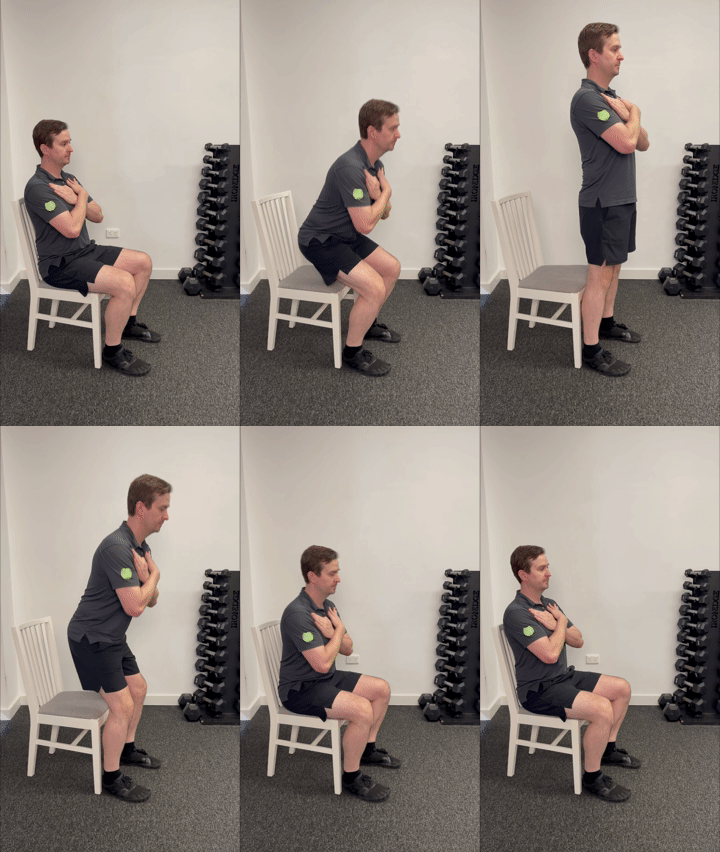
- Sit-to-Stands (STS): Standing up from a chair.
- Squats: The standard squat.
- Squat Variations:
- Paused Squats (pausing at the bottom to work the muscles harder)
- Tempo/Slow Squats (slower descent to work the muscles harder)
- Fast/Power Squats (faster ascent to build muscle power)
- 1.5 Squats (doing one-and-a-half squats: i.e. squatting all the way down, coming halfway up, going back down, and then finally coming all the way up)
Watch this video to see the different types of squats in action:
2. Why do we Squat?
We squat to build strong legs and resilient knees and hips. Squats also help build bone density through the legs, hips and spine. Stronger squats mean easier stairs, effortless stand-ups from low chairs, and improved ability to get up from the floor.
Muscles: It mainly targets your Quadriceps (front of thighs) and Glutes (bottom). Other muscles which contribute to a lesser extent include hamstrings (backs of thighs), adductors (inner thighs), abdominals, and back muscles.

|

|
Joints: They main joints moving under load in a squat are your knees and hips.
3. Our Squatting Philosophy: Go as Low as You Can Comfortably Manage
If your squats are feeling good, try to squat as low as you can comfortably manage.
The lower you squat, the harder your muscles and joints have to work. By challenging your joints through their full range, you build stronger muscles and more flexible, resilient joints.
Whichever version of the squat you are doing, always aim for the deepest version you feel you can safely and tolerably manage. By deepest, we mean getting your bottom as close to the ground as possible. Over time, you will likely be able to get lower and lower as you get better at squatting.
Some People Naturally Cannot Squat Deeply, and That’s Okay!
There is a wide range of normal variance in human anatomy. Whether it’s because of hip joint position and angle, ankle mobility or body proportions (such as torso to leg length ratio), the fact is some people just do not have bodies that are conducive to a deep, bottom-to-ground squat. And that’s okay.
Don’t compare yourself to others. Just squat as deeply as you feel you can manage.
4. How to Progress Your Squats
As you get stronger and more experienced with squats, you need to gradually make them harder so that you continue to challenge yourself. That’s how you keep making progress. For the squat there are 3 main ways to progress:
- Go deeper: Try to get your bottom as low to the ground as you can manage. As discussed above, you will reach you natural anatomical limit at some stage, in which case move on to the next progression.
- Do the harder version: The physio on the right side of your screen in almost all workouts is doing the harder version of the exercise. Choose the harder version if you can manage it.
- Add weight: Of course any strength/resistance exercise is made harder by adding weight.
Watch this video to learn how you can add weight to your squats:
5. Modifying for Pain
Most commonly it will be knee pain or hip pain which is the reason you’re having some trouble squatting. Although of course it could be something else instead; ankle, foot, back, etc.
Regardless, we want to try to find a way to keep squatting if we can, so the goal here is modify until it feels "tolerable". It is often okay to exercise through some discomfort, provided the pain feels tolerable to you and doesn't flare up significantly the next day.
Use our 3-Step Modification Toolkit:
Step 1: Reduce the weight
Try using a bit less weight than what you normally do. There’s no exact ratio to follow, but often trying a 25% decrease is a good start. If that doesn’t work, decrease it further. You can go to no weight at all (bodyweight squat or STS) if needed.
Step 2: Reduce the range of movement
Don't go as deep. Perform "mini-squats" or "half-squats". For the STS, add cushions to the chair. The lower you squat, the greater the range-of-movement your knees and hips must perform, so shallower is usually easier on them. Stay in the zone that feels tolerable.
Step 3: Vary the movement
Try varying your position. Once again, there’s no definitive rule here, just do some trial and error to see what works for you:
|
Wide stance
|
Narrow stance
|
|
Torso upright
|
Torso leaning forwards
|


If these don't work?
If you’ve tried all the above and it’s still not right, avoid the squats for a week or two, until hopefully your pain has settled down a bit and you can try again.
In place of the squats in the workout you could do:
- Sit to stands
- A gentle knee/quads exercise, such as seated knee extensions

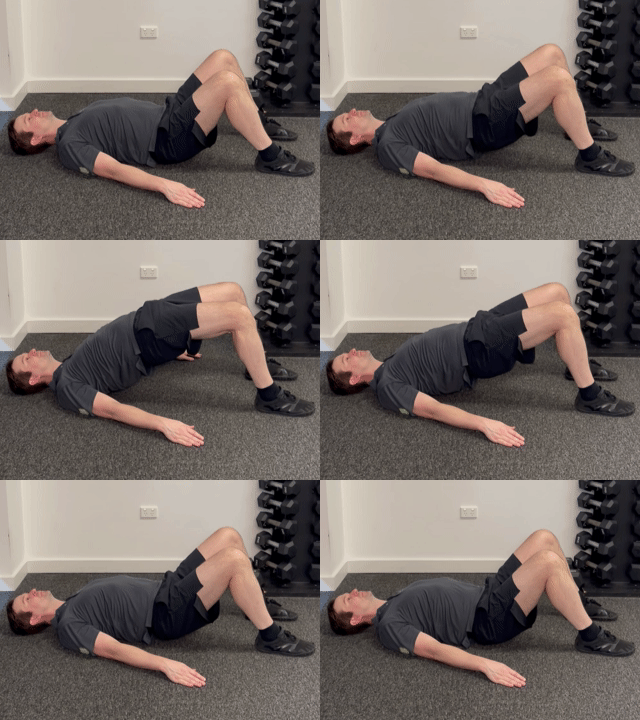
- An easier hip/glutes exercise, like a glute bridge
- A leg exercise which doesn’t load your knees or hips, such as a heel raise

Remember: Consistency beats perfection. Just keep moving!
6. Need more help?
- Check out our full guide to Knee Pain here
- Check out our full guide to Hip Pain here
- Check out our full guide to Osteoarthritis here
Otherwise, you can email us on info@bemobilephysio.com.au, and although we cannot give specific, individual physiotherapy/medical advice, we’ll do our best to steer you in the right direction.