How to Modify: Deadlifts
This guide is for educational purposes only, and should not be used as a substitute for professional medical advice, diagnosis, or treatment. The guidance here is general, and you should always listen to the advice of your personal healthcare provider.
This guide is for educational purposes only, and should not be used as a substitute for professional medical advice, diagnosis, or treatment. The guidance here is general, and you should always listen to the advice of your personal healthcare provider.
Table of Contents:
- What is a Deadlift?
- Why do we Deadlift?
- How to Progress Your Deadlifts
- Modifying for Pain
- Need More Help?
1. What is a Deadlift?
A deadlift is an exercise in which you lift a weight up from the floor. Whether you are picking up a heavy bag of potting mix, grabbing a laundry basket, or lifting a grandchild... you are doing a deadlift.

Common variations you’ll see in our workouts include:
- Deadlifts: As above.
- Romanian Deadlifts (RDLs): Start in a standing position, bow forward to lower the weight towards the floor (but don’t let it ouch the floor), and then stand back up.
- Split Stance Deadlifts: One foot is slightly in front. The front leg works harder.
- Single Leg Deadlifts: As the name suggests. The back foot comes right off the ground.
Watch this video to see the different types of deadlifts in action:
2. Why do we Deadlift?
The deadlift works many major muscle groups and is excellent for building bone density.
If you have a really strong deadlift, almost anything you encounter in daily life (laundry baskets, pots, bags of soil, pets, grandchildren, furniture) is an absolute breeze to lift, and you have the confidence your back can handle it.
Muscles: It primarily works your Glutes (bottom), Hamstrings (back of thighs) and several Back Muscles. You also get some contribution from quadriceps (thighs), adductors (inner thighs), abdominals, and it works your hand/forearm muscles (grip strength).

|

|

|
Joints: The primary moving joints are your hips, with some contribution from your lumbar spinal joints and your knees.
3. How to Progress Your Deadlifts
- Do the harder version: The physio on the right side of your screen in all workouts is doing the harder version of the exercise. Choose the harder version if you can manage it.
- Add weight: Of course any strength/resistance exercise is made harder by adding weight. Here’s how to add weight to your deadlift:
4. Modifying for Pain
If you feel pain during the deadlift, your goal is to find a version that feels "tolerable". Discomfort does not mean you are damaging your body.
Use our 3-Step Modification Toolkit:
Step 1: Reduce the weight
Try using a bit less weight than what you normally do. There’s no exact ratio to follow, but often trying a 25% decrease is a good start. If that doesn’t work, decrease it further.
Step 2: Reduce the range of movement (ROM)
Don’t lift the weight all the way from the floor. Place it on a step or a stack of books.

Step 3: Vary the movement
Try varying your position. There’s no definitive rule here, do some trial and error to see what works for you:
|
Wide stance
|
Narrow stance
|
|
More knee bend
|
Less knee bend
|
|
Straighter back
|
Rounded back*
|


* Yes, it is ok to lift weight with a somewhat rounded back. The "keep your back perfectly straight" idea is a myth. It is impractical, and in fact, impossible. Even in the image on the left, where Ollie's back looks "straight", there is actually still lots of flexion (forward bending) happening at the spinal joints. And that is ok, your back evolved to bend and twist.
There are currently zero high-quality studies demonstrating that lifting with a "straight" or "neutral" spine is safer or reduces low back pain (LBP) risk compared to lifting with a flexed spine. Recent systematic reviews (the top level of evidence) show no association between lumbar spine flexion during lifting and the onset or persistence of LBP, while biomechanical studies indicate that human spines naturally flex under load regardless of how the person is instructed to lift the weight (Saraceni et al., 2020; Mawston et al., 2021).
Deadlift in a way that feels comfortable for you, start with a weight you can manage, and build up gradually over time.
If these don't work?
If you’ve tried all the above and it’s still not right, avoid the deadlifts for a week or two, until hopefully your pain has settled down a bit and you can try again.
In place of the deadlifts in the workout you could do:
-
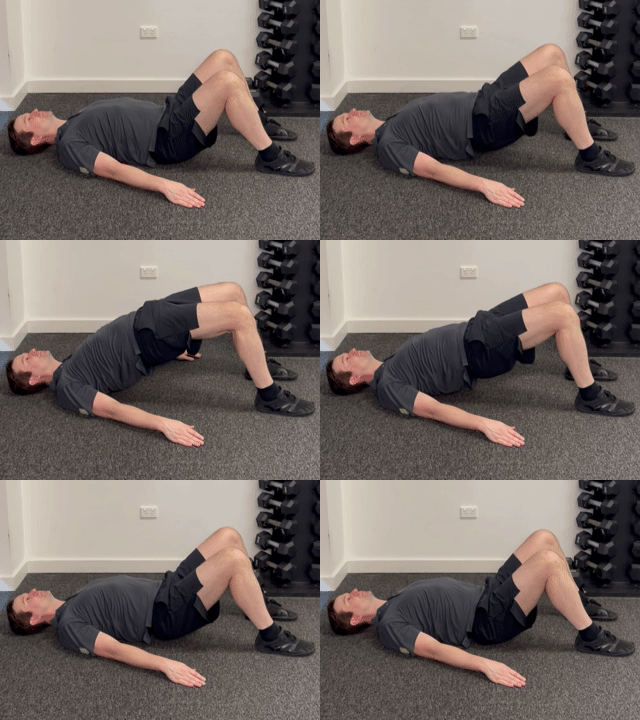
A gentler hip/glutes exercise, like a glute bridge
-
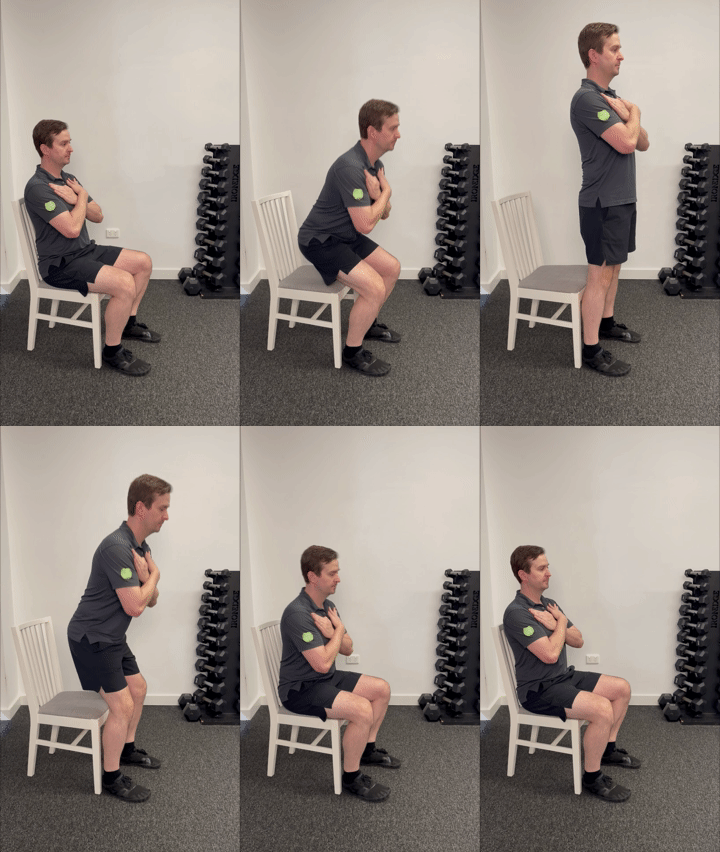
A sit-to-stand, to work you hips and legs without loading your back as much
-
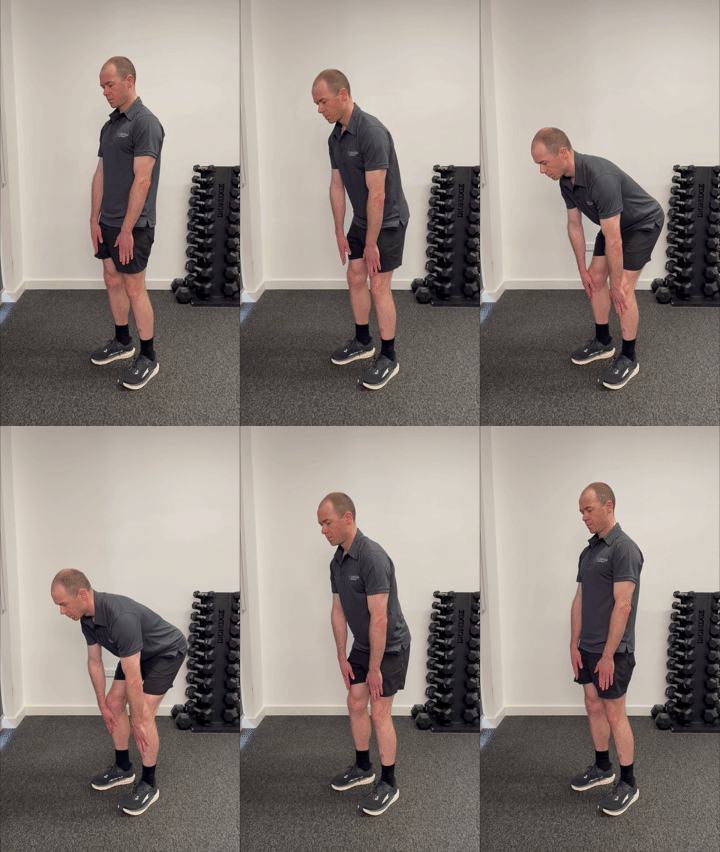
An un-weighted "toe touch" exercise. You don’t have to actually reach down all the way to your toes, you can start with a thigh touch, then gradually progress → knee → shin → toes
Remember: Consistency beats perfection. Just keep moving!
6. Need more help?
- Check out our full guide to Back Pain here
- Check out our full guide to Hip Pain here
- Check out our full guide to Osteoporosis here
Otherwise, you can email us on info@bemobilephysio.com.au, and although we cannot give specific, individual physiotherapy/medical advice, we’ll do our best to steer you in the right direction.
References:
-
Mawston, G., Holder, L., O'Sullivan, P., & Boocock, M. (2021). Flexed lumbar spine postures are associated with greater strength and efficiency than lordotic postures during a maximal lift in pain-free individuals. Gait & Posture, 86, 245–250.
-
Saraceni, N., Kent, P., Ng, L., Campbell, A., Straker, L., & O'Sullivan, P. (2020). To flex or not to flex? Is there a relationship between lumbar spine flexion during lifting and low back pain? A systematic review with meta-analysis. Journal of Orthopaedic & Sports Physical Therapy, 50(3), 121–130.